TIN - MEV Services
The Rakurai Transaction Inclusion Network (TIN) is a decentralized aggregator that brings lightning-fast inclusion and MEV sharing to Rakurai validators. It allows multiple transaction-landing services to access Rakurai validators, allowing them to access Rakurai stake and provide transaction and bundle order flow for inclusion.
For a validator, that is an additional source of rewards on top of block rewards & jito tips. For a searcher or landing service, it is a way to reach Rakurai stake through your own block engine and to use Pre-confirmation (Post-Pack Confirmation) from point of no return.
Why it exists. Instead of relying on a single revenue stream, a Rakurai validator receives high-quality orderflow from multiple transaction landing services for inclusion in the block. That is what lets the validator consistently capture higher rewards per block, and it needs no extra components.
Audience: TIN partners, block engines, MEV searchers, and traders sending bundles or consuming post-pack confirmations.
1. TIN building blocks
TIN is three pieces you integrate with. How the money is accounted for is in Revenue streams.
| # | Building block | What it does | Who uses it | Guide |
|---|---|---|---|---|
| 1 | Multi-block-engine orderflow | Rakurai validators connect to the block engines of every registered landing service and auto-select the lowest-latency endpoint | Block engines, landing services | Setup guide |
| 2 | Virtual priority boost | A SOL tip raises scheduling priority for your transaction/bundle, without cannibalizing priority fees | Searchers, traders, landing services | Tips |
| 3 | Post-pack confirmations (P2C) | The scheduler streams transactions from the point of no return, so you get a front-run-proof signal and can reply with a backrun bundle | Searchers, TIN partners | Post-pack confirmations |
1.1. Multi-block-engine orderflow
You register a discovery endpoint once with Rakurai. That host’s GetBlockEngineEndpoints returns your global_endpoint and any regioned_endpoints; validators probe and connect to the lowest-latency URL. Regional URLs live in your RPC response — not as separate on-chain entries. See Setup guide — discovery vs regioned endpoints. Reference sample: tin_sample_servers.
1.2. Virtual priority boost
A tip is a plain SystemProgram.transfer into one of the eight Rakurai tip accounts, included in your transaction or bundle. The scheduler reads that transfer as a priority signal. The important property is that it is additive: a transaction with a huge tip but almost no priority fee gains very little, which is what stops tips from eating the priority-fee market. See Tips.
1.3. Post-pack confirmations (P2C)
P2C emits an update at the point of no return rather than on ledger confirmation: early enough to be useful, late enough that nobody — including you — can front-run the original sender with it. Duplicate transactions are suppressed, so you receive one packet per transaction. You reply with a bundle containing the original packet unchanged plus your own transactions. See Post-pack confirmations.
2. Revenue streams
TIN revenue is managed through three on-chain accounts, each representing a revenue stream. Please refer to the diagram below for the TIN revenue streams and funds flow.
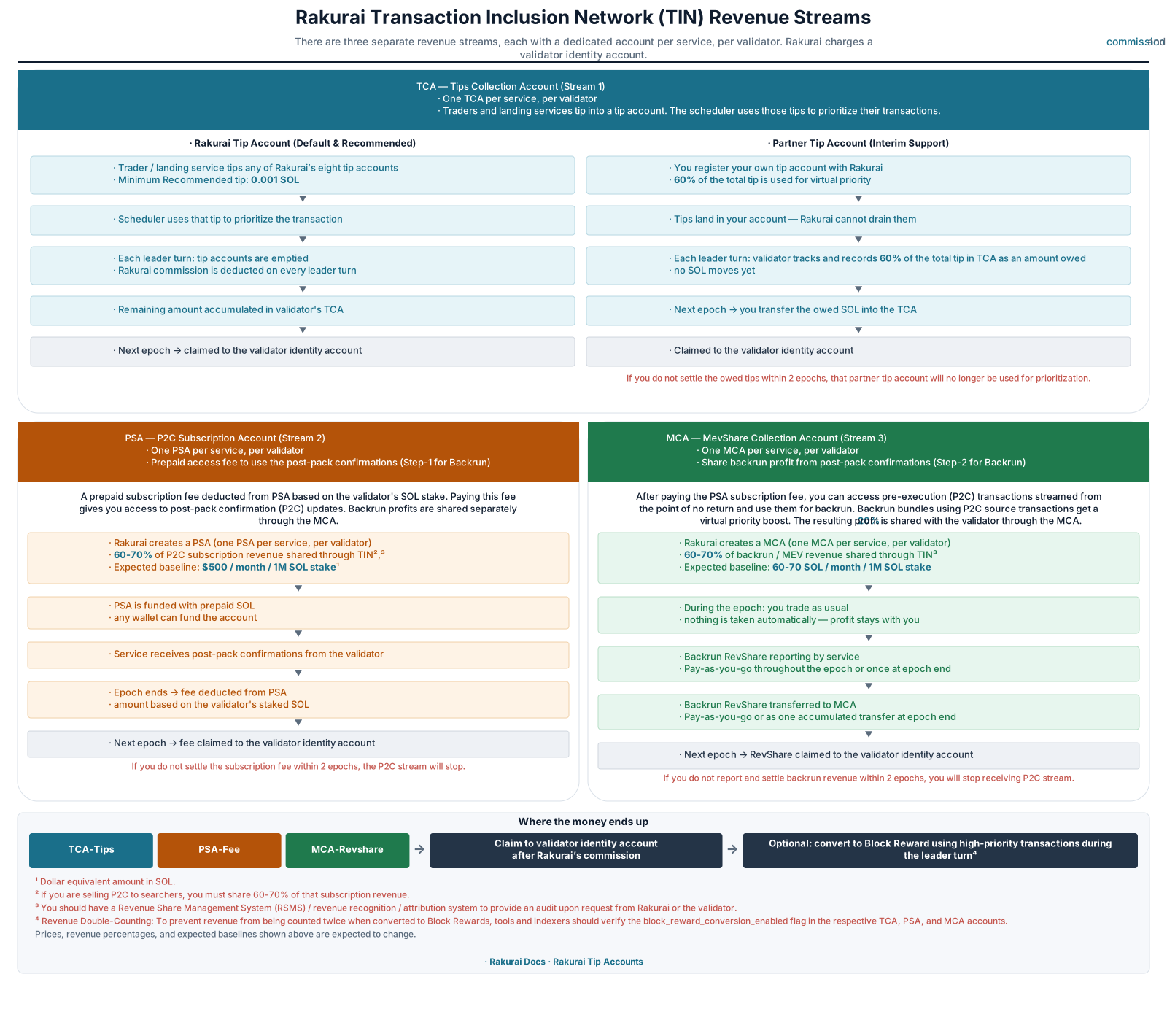
PSA comes before MCA — the subscription provides access to the stream, while the MCA shares the profit generated from that stream. Tips are independent of both and are recommended regardless.
Please refer to the Revenue Settlement Guide for a quick overview of revenue settlement and the associated CLI commands. Download the latest CLIs from the rakurai_programs releases.
| Stream | Account | What it is | When you pay | Docs |
|---|---|---|---|---|
| Tips / virtual priority | TCA | Tip into a tip account; the scheduler uses it to prioritize | At send time, per transaction or bundle | Tip Accounts Tips TCA |
| Post-pack confirmations | PSA | Prepaid fee to receive P2C updates, priced from the validator's stake | In advance; deducted each epoch | Rakurai-P2C CLI PSA |
| Backrun / MEV share | MCA | Your share percentage of profit made from the P2C stream | After each epoch, reported then sent | Rakurai-RevShare CLI MCA |
Full program overview: Reward Distribution.
3. What TIN means for you
3.1. If you run a Rakurai validator
- Better blockspace monetization — block rewards, tips, post-pack subscriptions, and backrun share, each accounted for separately.
- Access to higher-quality orderflow — multiple services bidding for the same blockspace instead of one.
- Increased rewards without extraneous components — TIN lives in the Rakurai client and the on-chain programs. There is no sidecar or additional daemon.
- You stay in control — Admin RPC lets you list and blocklist connected block engines and post-pack endpoints.
Start at Validators.
3.2. If you are a landing service, searcher, or trader
- Reach Rakurai stake through your own block engine.
- Pay for priority you actually need — tips move scheduling order, and the effect is bounded so it cannot be gamed with a zero-fee transaction.
- Buy a front-run-proof execution signal — post-pack is priced from validator stake, prepaid, and closable when you stop using it.
- Settle on-chain — what you owe is recorded on-chain and checkable with the CLIs.
Start at Setup guide, then Quick start.
4. Quick start
| Step | Action | Where |
|---|---|---|
| 1 | Understand what you will owe — TCA, PSA, MCA | Revenue settlement |
| 2 | Onboard — share your discovery endpoint and a wallet pubkey you control with the Rakurai team | Setup guide |
| 3 | Tip — 0.001 SOL recommended per tipped transaction or bundle, on top of priority fees | Tip accounts |
| 4 | Send traffic — bundles through your block engine | Setup guide |
| 5 | Add post-pack (optional) — fund the PSA, consume the stream, reply with backrun bundles | PSA |
| 6 | Settle each epoch — MCA, and custom-tip TCA if you use one; download CLIs from the latest release | Revenue settlement |
5. Guides
| Guide | Description |
|---|---|
| Revenue settlement | Rakurai/Partner tip TCA, PSA funding, MCA record+transfer — quick steps and CLI |
| CLI latest release | Prebuilt rakurai-revshare, rakurai-p2c, and other Rakurai CLIs |
| Setup guide | Global block-engine endpoint, gRPC services, onboarding, block-engine Admin RPC |
| Tips | Sending tips, virtual priority, custom tip accounts, TCA distribution |
| Post-pack confirmations | P2C overview, PSA, MCA, streaming and reply bundles |
| P2C Subscription CLI | Fund and inspect PSA |
| Tip and MevShare Revenue Settlement CLI | Settle TCA / MCA |
6. Do not double-count tips and converted block rewards
External indexers that watch transfers into Rakurai tip accounts and also watch validator block rewards can count the same SOL twice.
What happens on-chain:
- A tip (TCA), PSA fee, or MCA share is claimed to the validator identity.
- If
block_reward_conversion_enabledis set on that TCA / PSA / MCA account (this flag is on by default), the claimed amount is sent again as a high-priority block-reward transaction during a leader turn.
That block-reward transaction is the converted claim, not new revenue. If you already counted the tip (or the PSA/MCA payout), counting the later block reward as extra income is double counting.
How to avoid it
- Read
block_reward_conversion_enabledon the TCA, PSA, and MCA accounts (see Reward Distribution — block-reward conversion). - If the flag is on, count the money once: either at the tip / claim, or as the converted block reward — not both.
The conversion transaction must land in that leader turn or it is dropped (it is not forwarded to the next leader).
Related
- Validators — setup, upgrades, Geyser, attestation
- Programs — on-chain programs and CLIs